
Understanding Tree Watering Systems
[vc_row][vc_column][vc_column_text]You may think watering your trees is a job best done by Mother Nature but, if you want the trees in your landscape to stay healthy, you will need to step in from time to…

4.7 OUT OF 5 STARS
Trusted by homeowners
across the twin cities
[vc_row][vc_column][vc_column_text]You may think watering your trees is a job best done by Mother Nature but, if you want the trees in your landscape to stay healthy, you will need to step in from time to time. Watering your trees is an essential part of the tree care process and will better prepare your trees to fight off pests and diseases. But who has time to stand in their yard with a hose for hours? Luckily, there are tree watering systems that are easy to set up and use.
Drip Irrigation
Drip irrigation is a series of pipes that allow for deep watering that is slowly released over a long period of time. This requires roughly double the amount of time to release the water but it is the most efficient system for watering trees and results in minimized runoff and evaporation. A drip irrigation system has many advantages, including its ability to be automated and adaptable, but it needs to be inspected regularly to measure its effectiveness.
Soaker Hose
Soaker hoses are often seen coiled around the base of a tree and are a popular option because of how easy they are to set up. Special pins can be purchase to keep the hose in place, and mulch is recommended to minimize evaporation. If you decide on a soaker hose, save yourself some time and invest in a hose timer.
Sprinkler Systems
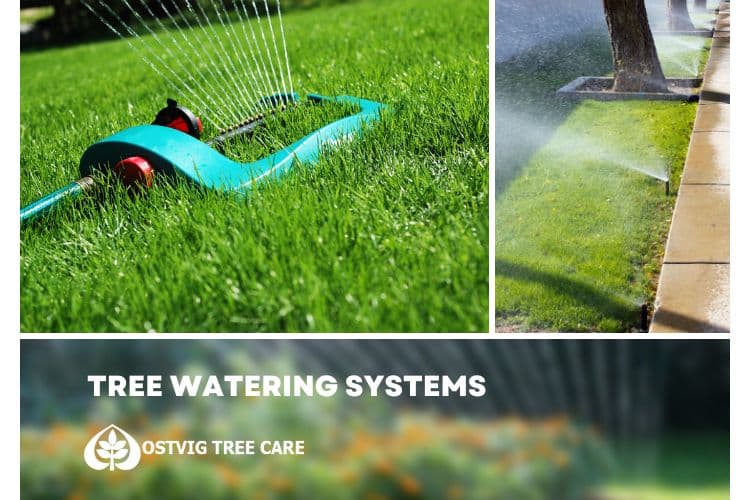
Sprinkler systems, although less efficient than drip or hose systems, are a perfectly suitable option for tree watering. These systems can result in runoff and evaporation but their benefits include portability and water volume. Plus, they can take care of other lawn watering needs.
Tree Watering Bags
If you have a very young tree that requires frequent watering, you may want to invest in a watering bag. These bags fit around the base of the tree, since the root ball is still small, and slowly release water. These bags are best for small drip lines, where a drip, hose or sprinkler system may be overkill.
What are the watering needs of my tree?
Many factors determine the watering needs of a tree including the soil type, age and size. These factors, along with the weather (rain or drought), could require you to water your trees anywhere from twice a week to once a month. This is why it’s important to understand the needs of your trees before purchasing a watering system.
Tips for Watering Trees
- Avoid compacting the soil around the roots of a new tree, as this can interfere with the amount of oxygen it receives.
- Make sure your tree receives roughly 10 gallons of water for every inch of its trunk diameter per week. For example, if a tree has a 10 inch diameter, it would need 100 gallons of water per week.
- Use mulch to retain the moisture but do not place it too close to the trunk of the tree (as this can cause the tree to rot).
- Avoid watering during the warmest times of the day to conserve your water source (i.e., water in the early morning or late evening).
- Test the moisture of the ground around the tree by drilling into the soil. If it becomes difficult to drill more than six inches, the tree needs to be watered.
- Remember that a tree’s roots extend beyond the drip line, so be sure to water beyond the canopy of the tree.
Want to learn more tips on tree watering? You can find common misconceptions about tree watering by clicking here.
[/vc_column_text][dt_blog_carousel post_type=”posts” dis_posts_total=”1″ posts_offset=”0″ image_sizing=”proportional” slides_on_wide_desk=”1″ slides_on_desk=”1″ slides_on_lapt=”1″ slides_on_h_tabs=”1″ slides_on_v_tabs=”1″ arrow_bg_width=”36x” arrow_border_width=”0px” r_arrow_icon_paddings=”0px 0px 0px 0px” r_arrow_v_offset=”0px” l_arrow_icon_paddings=”0px 0px 0px 0px” l_arrow_v_offset=”0px” posts=”3443″ css_dt_blog_carousel=”.vc_custom_1658064318024{padding-right: 100px !important;padding-left: 100px !important;}”][/vc_column][/vc_row]
Categories

Jim Ostvig
Few people know Minnesota trees like Jim Ostvig. As an ISA Certified Arborist and former owner of Ostvig Tree Care, he has built a career around providing practical, science-based recommendations that put the long-term health of trees first.
Related Posts
Jim Ostvig | August 14, 2026 | Tree Care Tips
Plant Health Care Programs: What’s Included & Why You Should Enroll
Plant health care keeps trees healthy for years. Discover what's included in a PHC program, why they save money compared to removal, and how to get started.
Jim Ostvig | August 14, 2026 | Tree Care Tips
Best Time to Prune Trees in Minnesota (And When to Avoid)
Discover the best seasons for tree pruning in Minnesota. Learn why winter is best for most trees, plus species-specific exceptions and disease risks to avoid.
Jim Ostvig | August 14, 2026 | Tree Pests and Diseases
Oak Wilt Prevention: Minnesota’s Year-Round Seasonal Guide
Worried about oak wilt? Learn when it spreads, how to recognize symptoms, and the best times to prune, treat, and protect Lake Minnetonka oak trees.
Have a Question We Haven't Covered?
Our ISA Certified Arborists are always happy to help. Reach out for a free consultation, or explore more articles in the Learning Center.