
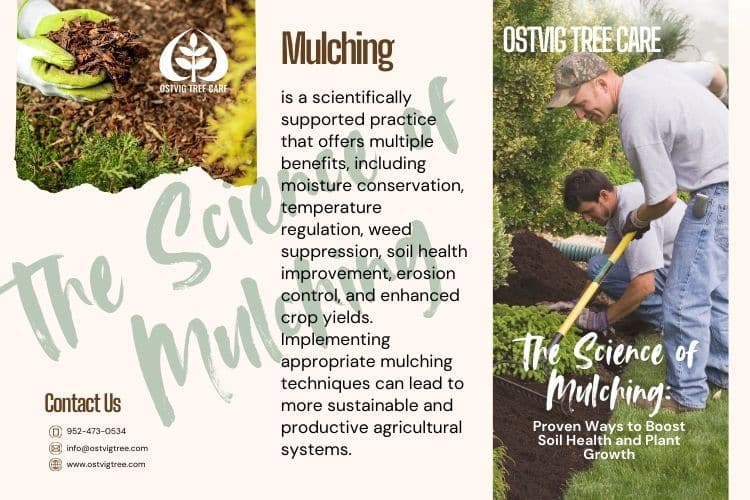
The Science of Mulching: Proven Ways to Boost Soil Health and Plant Growth
Mulching is a scientifically supported practice that offers multiple benefits, including moisture conservation, temperature regulation, weed suppression, soil health improvement, erosion control, and enhanced crop yields. Implementing appropriate mulching techniques can lead to more sustainable

4.7 OUT OF 5 STARS
Trusted by homeowners
across the twin cities
Mulching is a well-researched agricultural practice that offers numerous benefits to soil health and crop productivity. Scientific studies have documented its positive impacts in various areas:
Soil Moisture Conservation and Temperature Regulation
Research indicates that mulching significantly reduces soil evaporation and helps maintain optimal soil temperatures. A review published in Frontiers in Agronomy highlights that mulching lessens soil erosion and surface evaporation, thereby conserving soil moisture and providing a favorable environment for plant roots. frontiersin.org
Weed Suppression
Mulching effectively suppresses weed growth by blocking sunlight, which inhibits weed germination and reduces competition for resources. A study in the Bulletin of the National Research Centre confirms that mulching reduces weed growth, contributing to better crop yields. bnrc.springeropen.com
Soil Health Improvement
Organic mulches decompose over time, enriching the soil with organic matter. This process enhances soil structure, increases nutrient availability, and promotes beneficial microbial activity. A publication in Sustainability discusses how organic mulching improves soil quality, water retention, and erosion control, leading to enhanced crop growth. mdpi.com
Erosion Control
Mulching protects the soil from erosion by reducing the impact of raindrops and wind. This is particularly important in areas prone to heavy rainfall or on slopes, where soil displacement can be a significant concern. The same review in Frontiers in Agronomy notes that mulching lessens soil erosion, contributing to soil conservation efforts. frontiersin.org
Enhanced Crop Yield
Studies have shown that mulching can lead to increased crop yields. For instance, field trials with superhydrophobic sand mulches demonstrated yield increases ranging from 17% to 73% for crops like tomatoes, barley, and wheat. These findings suggest that mulching can be a valuable practice for improving agricultural productivity, especially in arid regions. arxiv.org
In summary, mulching is a scientifically supported practice that offers multiple benefits, including moisture conservation, temperature regulation, weed suppression, soil health improvement, erosion control, and enhanced crop yields. Implementing appropriate mulching techniques can lead to more sustainable and productive agricultural systems.
Categories

Jim Ostvig
Few people know Minnesota trees like Jim Ostvig. As an ISA Certified Arborist and former owner of Ostvig Tree Care, he has built a career around providing practical, science-based recommendations that put the long-term health of trees first.
Related Posts
Jim Ostvig | August 14, 2026 | Tree Care Tips
Plant Health Care Programs: What’s Included & Why You Should Enroll
Plant health care keeps trees healthy for years. Discover what's included in a PHC program, why they save money compared to removal, and how to get started.
Jim Ostvig | August 14, 2026 | Tree Care Tips
Best Time to Prune Trees in Minnesota (And When to Avoid)
Discover the best seasons for tree pruning in Minnesota. Learn why winter is best for most trees, plus species-specific exceptions and disease risks to avoid.
Jim Ostvig | August 14, 2026 | Tree Pests and Diseases
Oak Wilt Prevention: Minnesota’s Year-Round Seasonal Guide
Worried about oak wilt? Learn when it spreads, how to recognize symptoms, and the best times to prune, treat, and protect Lake Minnetonka oak trees.
Have a Question We Haven't Covered?
Our ISA Certified Arborists are always happy to help. Reach out for a free consultation, or explore more articles in the Learning Center.