
More than tree care: Why do cats climb trees?
At Ostvig Tree Care, we are more than the basics of tree care. We enjoy discussing common occurrences that come with having trees, like what to do when a cat climbs a tree. We all…

4.7 OUT OF 5 STARS
Trusted by homeowners
across the twin cities
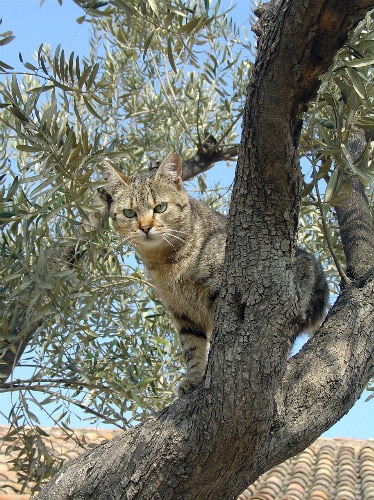
At Ostvig Tree Care, we are more than the basics of tree care. We enjoy discussing common occurrences that come with having trees, like what to do when a cat climbs a tree. We all know the classic scenario: a neighborhood tabby is pretending she is feral, spots a bird and goes for it. Before you know it, a fire truck is at the scene—along with the rest of the neighborhood—and very soon, the cat is safely back on the ground. Okay, it might not play out like that much anymore, but the cat-in-the-tree scenario still happens on occasion and it’s important to know the best way to approach the situation.
Why do they climb trees?
There are many reasons that cats climb trees, but the main reason has to do with their predatory nature. This background affects many of their habits, even as domesticated animals:
- Understanding their environment As predators, cats like to understand their environment. They know that from a higher vantage point, they will have a better view of their surroundings. This allows them to spot potential dangers and prey.
- Staying out of reach Cats often nap in trees instinctually because it is out of the reach of other predators.
- Stalking prey One of the most common reasons cats climb trees is to pursue other animals. When a domestic cat spots an inferior animal, such as a squirrel or bird, it’s instincts as a predator kick in. During this point in a chase, the cat may completely disregard its actions, in terms of the consequences of climbing a tall tree.
If they can get up there, why can’t they get back down?
In many instances, cats can get down from the tree on their own; they might just be frightened or want to come down by choice (which is a common cat attitude). In instances where it appears as though the cat can’t get down on its own, it may be because of the shape of its claws. Since cat claws are curved inward, they are able to grasp and hook onto the trunk of a tree to climb up. However, the inward curve is a disadvantage when it’s time to come back down to ground level.
What should I do if my cat can’t get down from a tree?
Your first instinct—or maybe you’ve been watching too many old movies or TV shows—may be to call the fire department. While we understand, as this cat may be a part of your family or a loving member of the neighborhood, we urge you to resist this instinct. Take a few cleansing breaths and follow these steps:
- Don’t panic Panicking will only make it worse for you and the cat. Cats can sense anxiety and will be less likely to come down to you if you are perceived as a threat.
- Remove the distraction(s) Try to pinpoint the reason the cat climbed the tree in (i.e. barking dog, anxious child, etc.) and remove the distraction from the scene (if possible.)
- Be patient If it appears as though the cat can get down on its own, be patient and wait it out.
- Call for backup If you need a professional to rescue the cat, it is best to call animal control, or a vet or nearby shelter.
While we don’t have much experience with cat-in-the-tree removal, we do provide a wide range of tree care services. Call Ostvig Tree Care today to set up an appointment.

Categories

Jim Ostvig
Few people know Minnesota trees like Jim Ostvig. As an ISA Certified Arborist and former owner of Ostvig Tree Care, he has built a career around providing practical, science-based recommendations that put the long-term health of trees first.
Related Posts

Jim Ostvig | August 14, 2026 | Tree Care Tips
Plant Health Care Programs: What’s Included & Why You Should Enroll
Plant health care keeps trees healthy for years. Discover what's included in a PHC program, why they save money compared to removal, and how to get started.
Jim Ostvig | August 14, 2026 | Tree Care Tips
Best Time to Prune Trees in Minnesota (And When to Avoid)
Discover the best seasons for tree pruning in Minnesota. Learn why winter is best for most trees, plus species-specific exceptions and disease risks to avoid.

Jim Ostvig | August 14, 2026 | Tree Pests and Diseases
Oak Wilt Prevention: Minnesota’s Year-Round Seasonal Guide
Worried about oak wilt? Learn when it spreads, how to recognize symptoms, and the best times to prune, treat, and protect Lake Minnetonka oak trees.
Have a Question We Haven't Covered?
Our ISA Certified Arborists are always happy to help. Reach out for a free consultation, or explore more articles in the Learning Center.