
Helpful Tips for Mature Tree Care
While proper tree care is important for the growth and nurturing of new, young plantings, it is equally imperative to care for the mature trees on your property. Mature trees often stand out, becoming the…


4.7 OUT OF 5 STARS
Trusted by homeowners
across the twin cities
While proper tree care is important for the growth and nurturing of new, young plantings, it is equally imperative to care for the mature trees on your property. Mature trees often stand out, becoming the identifying characteristic of our yards. For many of us, they signify home. They also add value to your property and act as sun and wind barriers (especially shade trees). Below are some pointers to ensure that your mature trees maintain their livelihood.
Tree Inspection
Inspecting your mature trees for diseases, insects and environmental problems at least once a year is crucial. Many city websites, including that of Medina, Minnesota, post common tree diseases in the area which can simplify your inspection process. To determine the health of your trees, you should track: new leaves or budding, leaf size, twig growth and crown dieback. If there is a stunt in new leaves or budding, leaf size or twig growth, further attention may be needed. Tree disease can also be indicated by trunk decay, crown dieback, loose bark or deformed growths. Be sure to log your inspections over several years to ensure a solid comparison.
Watering
Although mature trees can often withstand dry, sun-soaked conditions better than young trees, it is still essential that they maintain their moisture. On a hot, sunny day, a mature tree can lose over 200 gallons of water. In the absence of heavy rain, a monthly deep watering of about eight hours, depending on the type of tree, is recommended.
Pruning
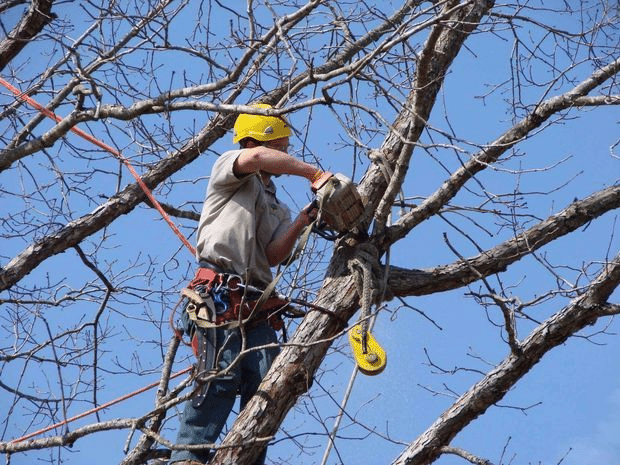
Pruning not only rids your trees of dangerous limbs, but it also helps your trees grow at a healthy rate. Mature trees often have high branches that require pruning with the use of a ladder or lift. If this is the case for your trees, or if your pruning requires a chain or hand saw, be sure to call a certified arborist, such as Ostvig Tree Care. They have the knowledge and experience to complete the pruning safely and efficiently. Once the pruning has been completed, make sure the tree is watered and fertilized to assist in the healing process.
Mulching
Mulch helps your trees absorb and maintain moisture and nutrients. Be sure to spread mulch 2-4 inches deep, above the root system. Remember that with a mature tree the root system may reach beyond that of the tree’s branches. It is important to keep the root system area cooler and more moisturized than the rest of your soil, as this is how the tree receives its nutrients.
Fertilization
Fertilization is essential for providing nutrients that aren’t otherwise available in your soil. Be sure to test the soil nutrient content to see if you need fertilizer. Healthy mature trees may not need fertilizer as they are already most likely receiving essential nutrients. If you find that your trees aren’t receiving the proper nutrients, spread fertilizer during the fall or early spring.

Categories

Jim Ostvig
Few people know Minnesota trees like Jim Ostvig. As an ISA Certified Arborist and former owner of Ostvig Tree Care, he has built a career around providing practical, science-based recommendations that put the long-term health of trees first.
Related Posts
Jim Ostvig | August 14, 2026 | Tree Care Tips
Plant Health Care Programs: What’s Included & Why You Should Enroll
Plant health care keeps trees healthy for years. Discover what's included in a PHC program, why they save money compared to removal, and how to get started.
Jim Ostvig | August 14, 2026 | Tree Care Tips
Best Time to Prune Trees in Minnesota (And When to Avoid)
Discover the best seasons for tree pruning in Minnesota. Learn why winter is best for most trees, plus species-specific exceptions and disease risks to avoid.
Jim Ostvig | August 14, 2026 | Tree Pests and Diseases
Oak Wilt Prevention: Minnesota’s Year-Round Seasonal Guide
Worried about oak wilt? Learn when it spreads, how to recognize symptoms, and the best times to prune, treat, and protect Lake Minnetonka oak trees.
Have a Question We Haven't Covered?
Our ISA Certified Arborists are always happy to help. Reach out for a free consultation, or explore more articles in the Learning Center.